Some walks you do once and never feel the urge to repeat. This one I do at least twice a year.
It never begins in a particularly athletic fashion. If you’re driving to Saint-Cézaire from Cannes, it’s the usual routine: out of town, up the pénétrante, through Mougins, round the Grasse roundabout, and three minutes later — JJ bakery. One of those rare places where the pastries come so close to perfection that it is officially criminal not to stop. And wonderfully, there is no guilty pleasure in it — whatever you’ve just eaten will, in any case, have vanished without a trace in about an hour. Assuming, of course, that guilt is something you occasionally suffer from.
The bakery is also a frontier. The moment you leave it behind, it feels as though you’ve crossed into another country. Cabris appears high on the hillside, the view opens wider with every bend, and suddenly there is nothing but forest. Then you’re in Saint-Cézaire.
Park in the village square. Have that little internal “well…” moment when you realise you’ve somehow ended up in Provence. Somewhere nearby pétanque balls knock against each other. The language is still French, but now you begin to hear the unmistakable Provençal drawl — paign, biegn. Cross the gorge and that’s simply how everybody speaks. Wander through the village. Stop at the viewpoint. Have an entirely athletic glass of chilled rosé. At this point nobody has actually gone anywhere, yet somehow the day is already turning out rather well.
Far below, you can clearly hear the river. Running water has an extraordinary ability to make you feel cooler before you’ve even seen it. The path dives into the trees. Three hundred metres later comes the first inconvenient thought. I’ll have to climb all this back. For the moment it’s dismissed without much concern. In another couple of hours it will occupy the entire mind. Until then, we keep dropping down the stone steps, some of which almost certainly remember the sound of Roman sandals. Two thousand years ago, and for centuries afterwards, this was the route that carried olive oil and grain from the Saint-Cézaire plateau, on foot and by mule, to what was then civilisation on the coast — Fréjus.

Before long the trail confronts you with a rather uncompromising choice. Do the full route, including the chapel of Saint-Saturnin, or take the sensible — some would say faint-hearted — option and stop at the bridge. Entirely your decision. I turn left. Bold decisions are wonderfully easy before gravity begins asking for repayment.
Relict pines fill the air with that sweet, resinous scent only Mediterranean forests seem capable of producing. A sheer limestone cliff rises on the left. The river grows steadily louder somewhere below on the right. Eventually the chapel appears between the trees.
Back in the twelfth century it wasn’t an isolated little chapel hidden in the forest at all. The monks of the Lérins Abbey, which owned these lands at the time, built it as the parish church for the local community. For another five centuries it remained the centre of parish life, until a larger church was finally built up in the village in 1722.
The door is never locked. Push it open and step inside. Unexpectedly cool. On the left stands a stone font polished smooth by centuries of hands. Wooden benches. A modest altar. A rosary. A crucifix. Flowers, long dried yet somehow even more beautiful, in full harmony with the place. Little handwritten notes left by strangers. I lie down along one of the benches and study the pattern of cracks spreading across the curved vault overhead. A moth fusses around the tiny window near the ceiling. The place smells of old dry stone, woodland… and just a hint of the river.


It’s difficult to leave. My legs simply refuse. One more minute sitting in the grass outside. Looking at the cliffs. Then off again.
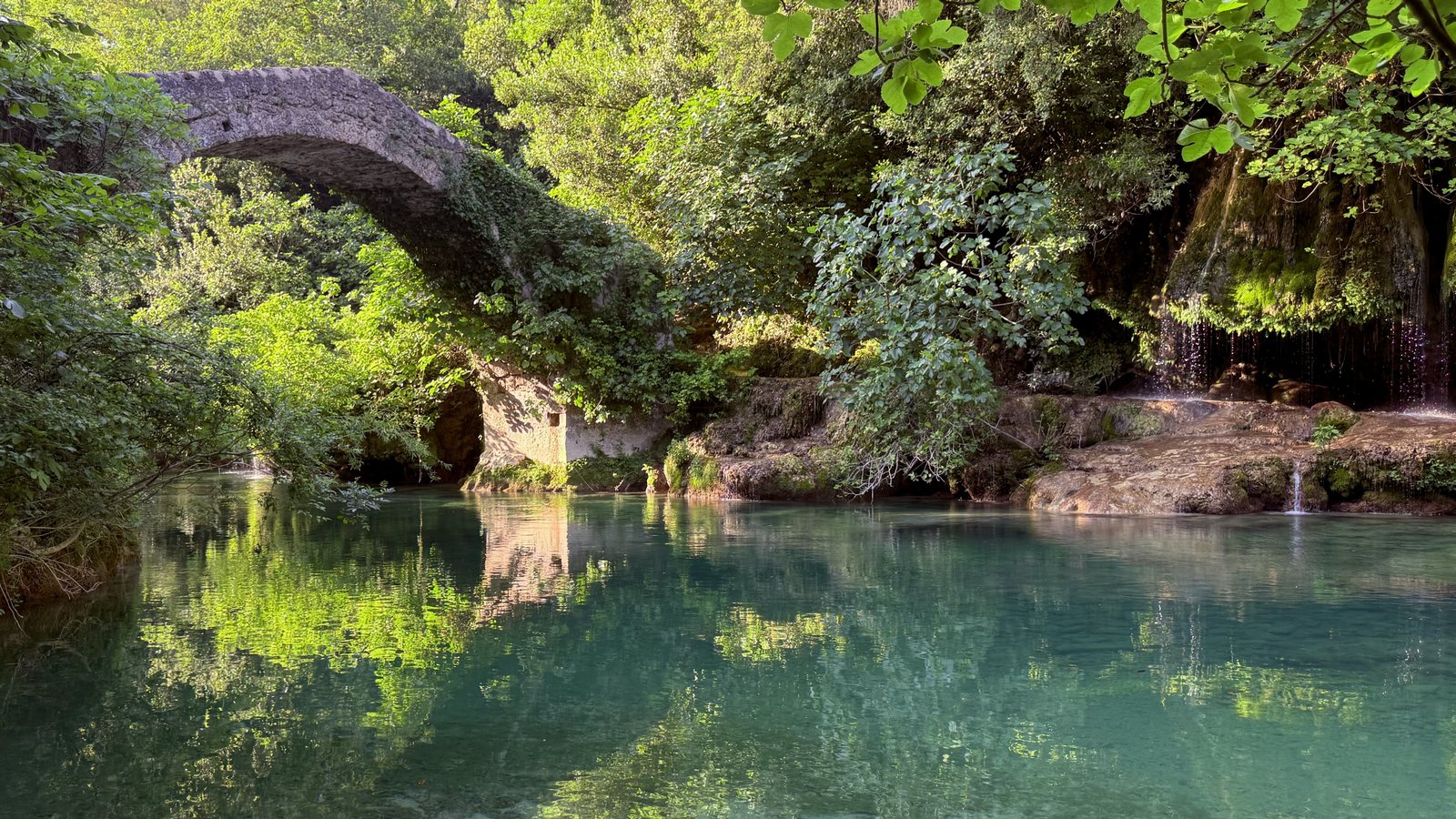
The path climbs over rocks and knotted roots until it reaches the old irrigation canal. From there the trail follows the gently flowing water. Daisies. Bellflowers. Bees. Tiny footbridges. A signpost. Then another descent. The ruins of an old stone mill appear. Beyond them, at last, the river. An entirely unreasonable shade of malachite green. Loud. Alive.

A couple of hundred metres later comes the bridge. From this side it’s Pont des Gabres. From the opposite bank it’s Pont des Tuves. An eternal illustration of the French conviction that whatever happens to be on my side is unquestionably mine, however absurd the argument may appear. Not really my dispute. Best simply accept it and carry on.
Approaching from Saint-Cézaire, you reach the bridge beneath a tiny rocky overhang where a little waterfall trickles onto the path. Ice-cold drops run down your back. Sunlight catches every thread of water. Once again, you find yourself reluctant to move on.
The bridge is often busy, particularly in summer — in case two human beings and a dog make up a party big enough to frighten you off. The pool beneath is deep enough for the more fearless to jump in. As a certified rescue diver, whenever I see people doing things like that, I instinctively look around and try to work out where a rescue helicopter might possibly land if it all goes wrong. I can’t find anywhere. So I prefer to sit quietly on the bank, eat something from my rucksack, wash it down with something from my flask, lie on the gravel beach a little further upstream, and then carry on. Per aspera ad astra, as they say — through hardships to the stars. Or, less romantically — who am I kidding? — simply to find out what legs are actually for.
Eventually every day comes to an end, and this one is no exception. The final climb back to the village is short, steep and remarkably effective at reminding you that every descent has consequences. Reaching the first houses brings that quietly satisfying feeling of having earned the day. The walk back to the car park is accomplished with slightly unreliable legs.
One final stop remains. I honestly don’t know how many people order proper meals in the cafés around the square. But judging by the number of glasses on the tables, very few leave without a thoroughly chilled beer or a glass of rosé. Entirely understandable — and entirely shared.

As for the best season… I love it most in spring, from April to June, when the fresh leaves remind you what the colour green is actually supposed to look like, and the little waterfall still has enough water to deserve being called one. Or October and November. Golden autumn. That hardly needs explaining.
A few practicalities. Dogs are welcome. Children too, although I’d probably say seven years old at the absolute minimum, and even then I’d stick to the shorter walk as far as the bridge. Wear proper outdoor clothes. If you insist on suffering in jeans, that’s your affair. What isn’t optional is decent walking shoes. The Romans probably managed perfectly well in sandals. Then again, the Romans did all sorts of things. Not all of them deserve repeating.